
The incident desk for DPDP Personal Data Breach Response
Assess, contain and notify. Run the Board and Data Principal duties of Rule 7 from one workspace, with every legal clock counted from the moment your organisation became aware.
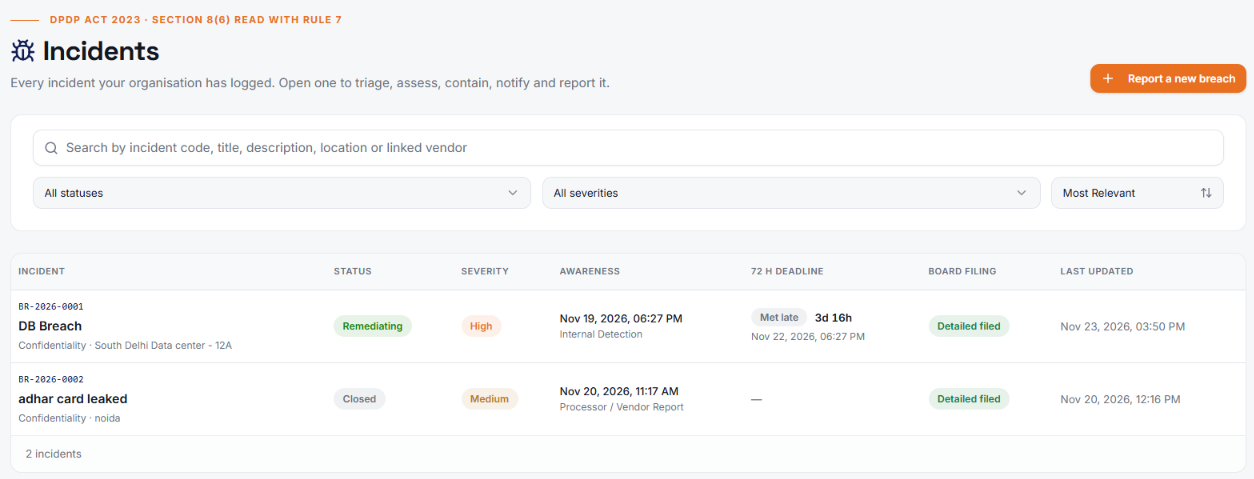
One record for the whole breach, from first alert to closure
Responders, DPOs and administrators work on the same incident, each with the actions their role allows.
Incident Response Workspace
Responders record the incident, the awareness time that starts the clocks, a structured assessment and the containment actions taken, with a DPO verifying each gate.
- Awareness time set once; later corrections need a justification
- Assessment of affected principals, data categories, location and likely impact
- Containment actions logged with owner, time and outcome
- CERT-In checklist with its own 6-hour indicator
Data Protection Board Reporting
DPOs prepare the initial intimation and the detailed report from structured sections, track the 72-hour deadline and request an extension when more time is needed.
- Initial intimation and 72-hour detailed report as structured forms
- Countdown to the Board deadline with overdue alerts
- Extension requests drafted, approved and tracked to the Board response
- Export as PDF and structured data for manual submission
Data Principal Notification
Prepare a plain-language notice with every mandatory element, preview it, send it to the affected Data Principals and watch delivery progress.
- Notice carries all five mandatory elements of Rule 7(1)
- Affected principals loaded from a CSV batch and reviewed before sending
- Delivery status per recipient, with failures flagged for follow-up
- DPO approval before any notice goes out
Built for the way DPDP actually expects you to respond
From the first alert to the closure summary, every deadline and decision is visible and recorded.
Deadlines That Count Themselves
The 72-hour Board clock and the CERT-In window start from the recorded times, with status colours and overdue alerts on every incident.
Every Breach Is Reportable
DPDP sets no materiality threshold. Severity helps you prioritise but never blocks or skips a notification.
DPO Approval Gates
Analysts do the work; a DPO verifies the assessment, confirms containment, approves notices and closes the incident.
Processor-Caused Breaches
Link the vendor involved, so the fiduciary owns the notification duty even when a processor caused the incident.
Tamper-Evident Audit Trail
Every status change, document, notice and report is logged with user and IST timestamp, and forwarded to the unified compliance chain.
Plain-Language Notices
Guided fields keep Data Principal notices clear and complete, and a preview shows exactly what each recipient receives.
From first alert to closed incident in 6 steps
A guided workflow that moves forward as each stage is completed and verified.
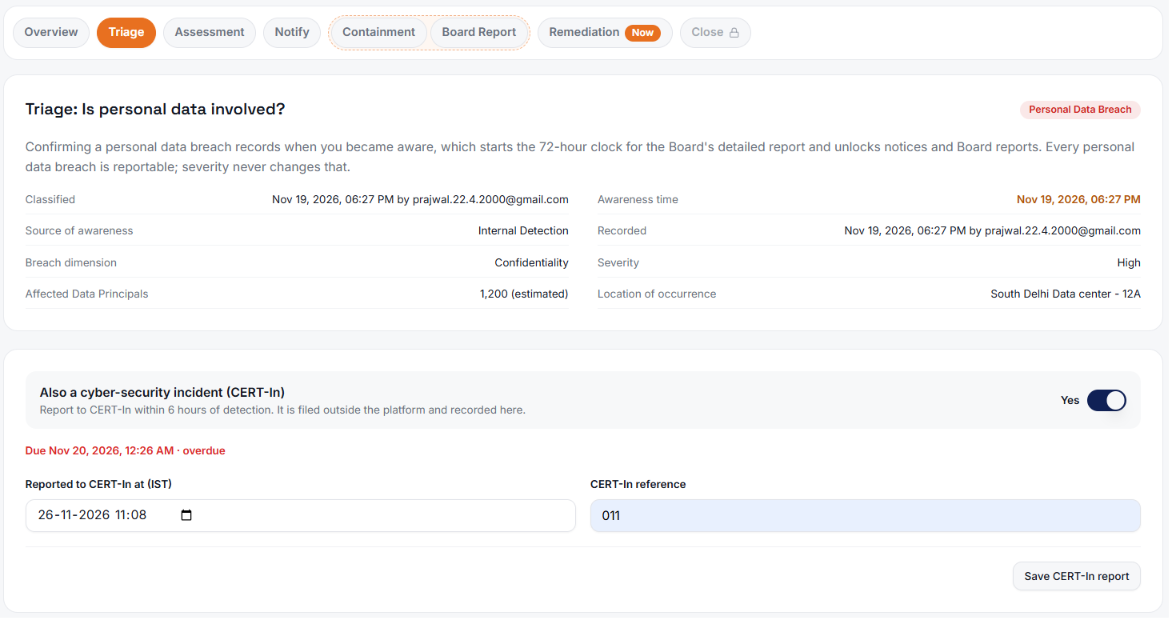
Report the incident and start the right clocks
Record what was detected and when your organisation became aware that personal data was involved, then classify it as a personal data breach or not.
- Detection time, awareness time and source of awareness captured
- Awareness is immutable; corrections are audited with a reason
- Classification with a mandatory justification for non-breaches
- Severity and breach type (confidentiality, integrity, availability)
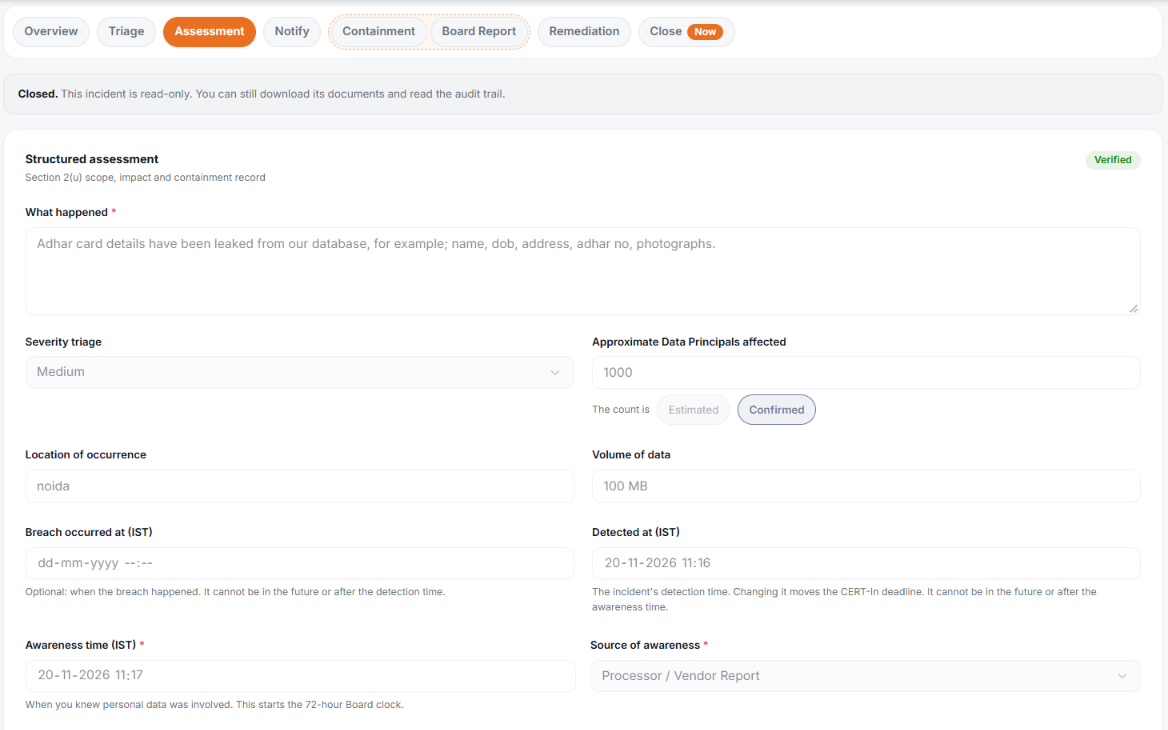
Structured assessment, verified by the DPO
Analysts describe the scope and impact in structured fields. The DPO verifies the assessment or returns it with a comment.
- Approximate number of Data Principals affected
- Data categories involved and location of occurrence
- Likely impact and consequences for individuals
- Edits to a verified assessment take it back to draft
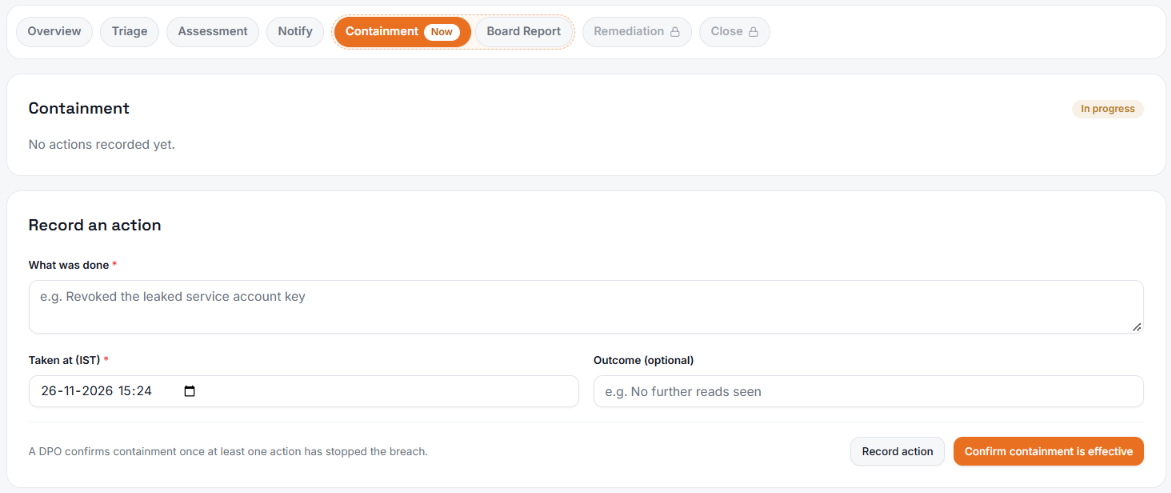
Log what was done to stop the breach
Record every containment action and attach evidence. A DPO confirms containment is effective before the incident moves on.
- Actions with owner, time taken and outcome
- Evidence and correspondence uploaded to the incident
- DPO confirmation of effective containment
- Chronological timeline of everything done on the incident
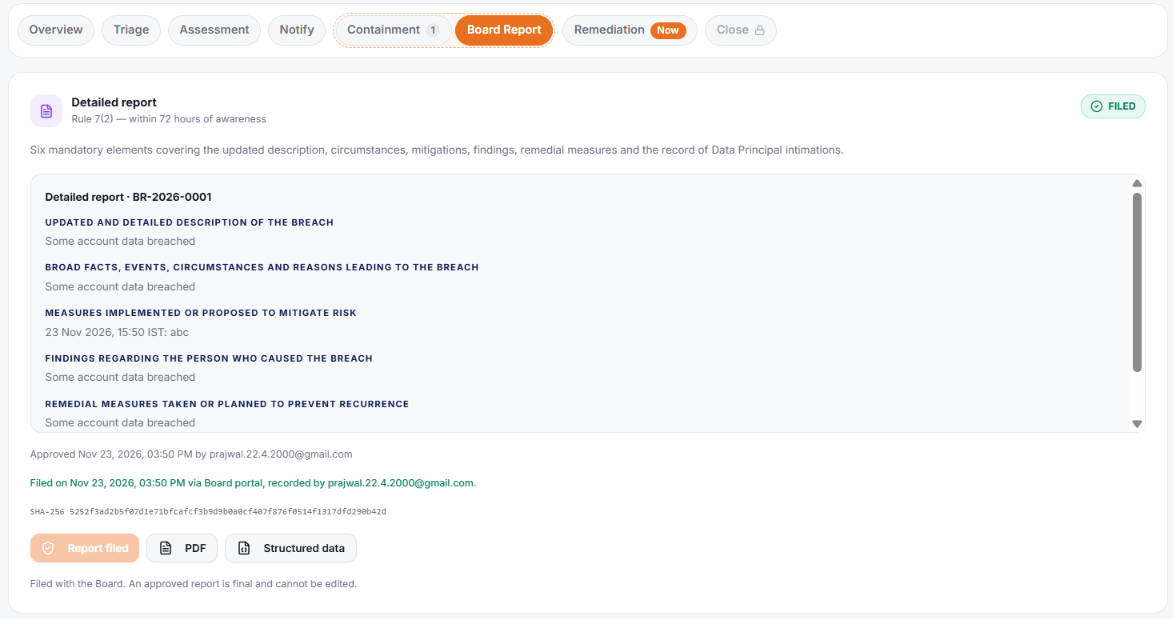
Initial intimation and the 72-hour detailed report
Prepare both Board reports from structured sections, get them approved, and keep the submission on record.
- Initial intimation with nature, extent, timing, location and likely impact
- Detailed report covering facts, mitigation, findings and remedial measures
- Extension requests with the Board response tracked
- Draft, approved and submitted states with a revision history
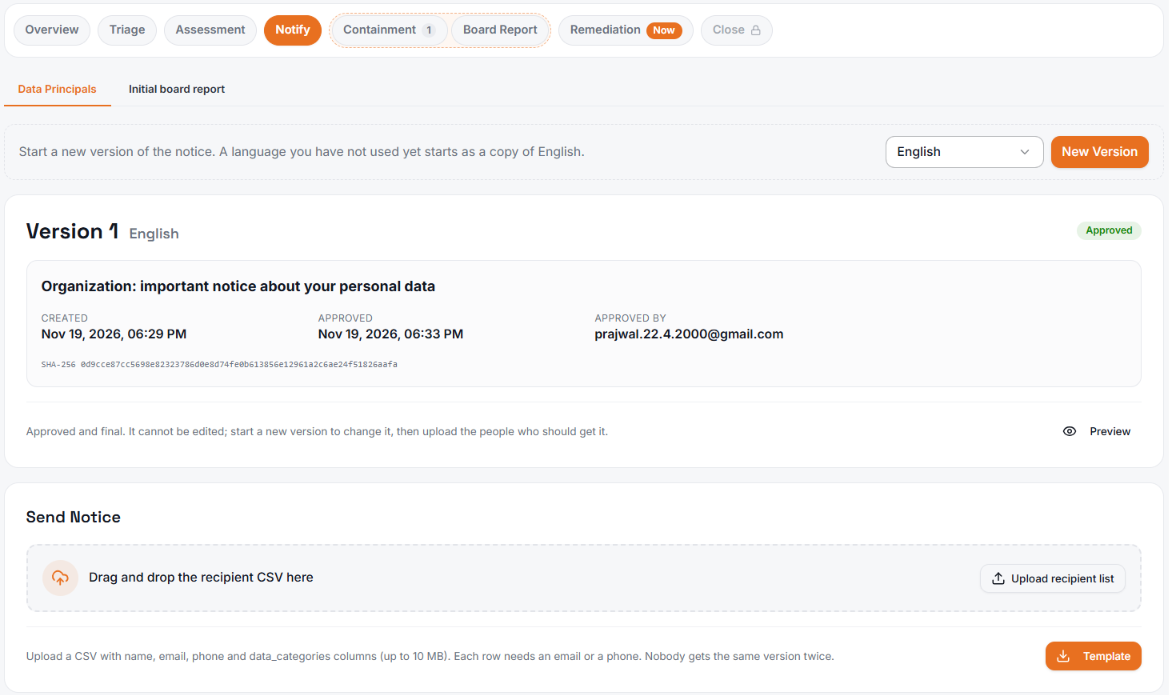
Notify every affected Data Principal without delay
Build the notice, upload the affected principals, run a preflight check, then send and monitor delivery.
- Five mandatory elements guided field by field
- CSV upload of affected principals, accepted or discarded after review
- Preflight check before the run starts
- Run progress and per-recipient delivery status
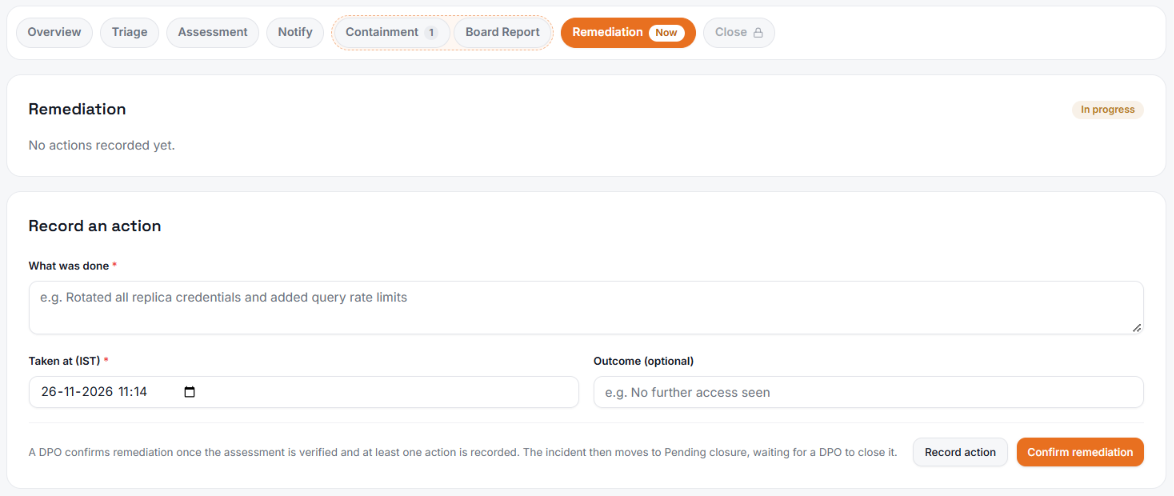
Confirm remediation, close with a summary
A DPO confirms the remediation measures and closes the incident with a closure summary once the detailed report is submitted.
- Remediation measures recorded and confirmed by a DPO
- Closure only after the detailed report is submitted
- Closure summary recorded with the incident
- Complete audit timeline for any regulator or auditor
Every incident with status, severity, awareness time and owner.
72-hour Board clock and CERT-In window with overdue alerts.
Initial and detailed reports with approval, submission and export.
Notices with delivery tracking for every affected Data Principal.
Open incidents, approaching deadlines and notification progress.
A timestamped record of every action, document and decision.
Questions, answered
What does DPDP require after a personal data breach?
Under Section 8(6) and Rule 7, a Data Fiduciary must inform each affected Data Principal without delay, give the Data Protection Board an initial intimation without delay, and send a detailed report within 72 hours of becoming aware of the breach. Breach Management tracks all three duties on the same incident.
Is there a threshold below which a breach need not be reported?
No. DPDP has no materiality or risk threshold, so every confirmed personal data breach is treated as reportable. Severity in the product is for prioritisation only.
When does the 72-hour clock start?
From the awareness time your organisation records, the moment it became aware that personal data was involved. The platform keeps that timestamp immutable; a correction needs a justification and is audited.
Does it replace CERT-In reporting?
No. The incident carries a checklist item and a 6-hour indicator so a parallel CERT-In obligation is not missed, but the report to CERT-In remains your own filing.
Can I submit reports to the Board from the platform?
Reports are prepared, approved and exported as PDF and structured data for manual submission, and you record the submission in the incident. Direct submission will follow once the Board publishes an official channel.
Who can use Breach Management?
Analysts, DPOs and organisation admins of a Data Fiduciary. Analysts work on incidents; DPOs and admins verify, approve, submit and close.
Be ready before a breach happens
Set up your incident desk now, so the Board and Data Principal duties of Rule 7 are met on time, with a record to prove it.